
New MRI approach may identify active MS lesions without contrast
MRx mapped more than 20 brain biomarkers in a single scan
Written by |
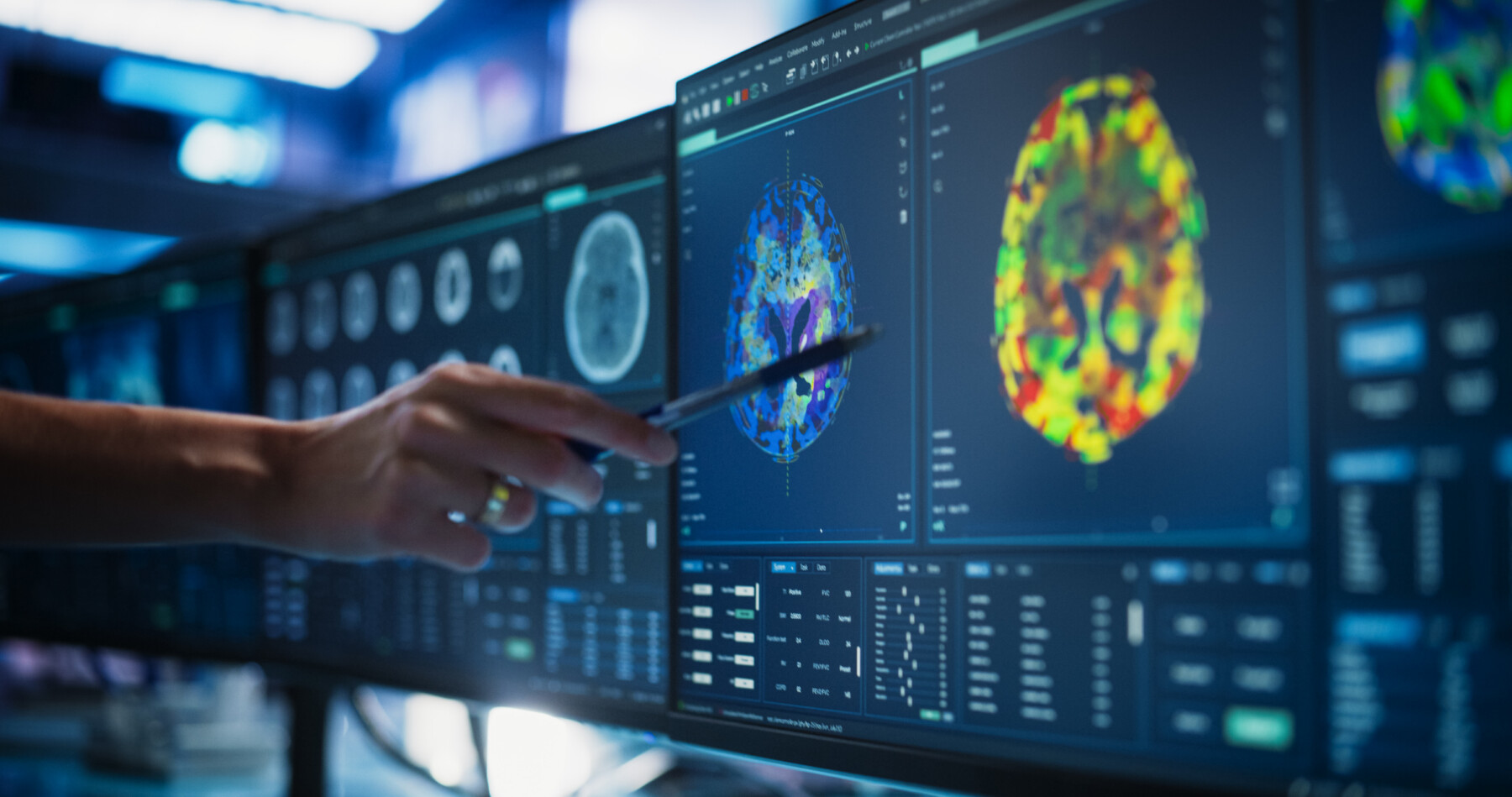
A doctor points at a patient's scan on a desktop computer monitor. (Photo from iStock)
-
New MRx imaging may identify active MS lesions without contrast dye.
-
The AI-powered scan maps more than 20 brain biomarkers linked to inflammation, myelin damage, and other tissue changes.
-
MRx may offer faster, more detailed insight into MS lesion activity and progression.
A new type of MRI scan may be able to distinguish active multiple sclerosis (MS) lesions from chronic lesions — without the need for injected contrast dye — while also offering clues about how lesions may evolve over time, a new study reports.
By combining artificial intelligence with advanced MRI methods, the experimental imaging approach can capture biological changes linked to inflammation, myelin damage, nerve fiber injury, and metabolic activity in a single brain scan.

MRx maps many brain markers in one scan
The tool, called multiplexed MRI (MRx), may provide important insights to clinicians caring for people with MS and other neurological conditions — information that current MRI scans often cannot provide on their own.
“MRx is a new artificial-intelligence-powered imaging framework that can measure many markers without the need for contrast agents,” Rong Guo, co-author of the study and a former student at the University of Illinois Urbana-Champaign, said in a university news story. “This gives clinicians and researchers better understanding of not only the brain’s structure, but also its physiology and molecular processes, within a single imaging framework.”
Guo and colleagues described their new technology in Nature, in a paper titled “Multiplexed magnetic resonance imaging.”
“Diseases such as tumors, multiple sclerosis and neurodegenerative disorders are highly heterogeneous. The rich set of biomarkers obtained using MRx has the potential to provide deeper insights into brain function and disease processes, while also improving the sensitivity and specificity of detection and diagnosis,” said Yudu Li, first author of the paper at the University of Illinois.
MRI scans are one of the most important clinical tools used to diagnose and track disease progression in people with MS.
Very simply, a traditional MRI uses powerful magnets and radio waves to generate signals from water molecules within the body’s tissues. Because the human body is mostly water, a computer can decode these signals to create images of the brain and other internal organs.
Current MRI scans have limits in MS
Because most conventional clinical MRI scans primarily rely on signals from water molecules, there are limits to what these scans can show. For example, in people with MS, a traditional MRI scan can detect brain lesions — areas of damage — but may not clearly distinguish active inflammatory lesions from chronic ones.
In current practice, identifying active MS lesions often requires an injected contrast agent called gadolinium, along with multiple MRI sequences, which can make the process time-consuming and complex.
MRx aims to expand the capabilities of MRI by mapping more than 20 brain biomarkers at once, including markers of inflammation, demyelination, damage to nerve fibers, and metabolic activity.
The imaging technique still uses the same magnet-and-radio-wave setup as traditional MRI, but takes advantage of modern computational advances to decode signals from many more molecules than just water. A whole-brain MRx scan can be completed in about 14 minutes, compared with up to an hour for conventional multicontrast clinical MRI protocols, the researchers said.
“With our integration of ultrafast data acquisition and physics-based machine learning methods for data processing, MRx overcomes several longstanding bottlenecks to fast, high-resolution multiplexed imaging,” said Guo.
MRx distinguished active and chronic lesions
The researchers tested their new technology by imaging brains from healthy people, as well as individuals with MS or brain tumors.
Across samples, MRx provided insights that would be difficult to obtain with traditional MRI scans alone. For example, in people with MS, the new imaging tool was able to identify active lesions without the need for a contrast agent.
In one MS example, MRx signals from an initial scan helped predict how tissue changed over a four-month follow-up. Researchers could detect tissue changes suggesting that a lesion would form in the future, or see signs suggesting that an existing lesion would remain stable or shrink over time.
“Our work … demonstrated that MRx could improve the detection and characterization of MS, including: (1) distinguishing chronic and active lesions without external contrast-enhancing agents and (2) discriminating MS lesions with different progression trajectories,” the researchers wrote.
The researchers noted that more validation of this approach is needed, but they are hopeful that this new imaging technology could eventually advance care for MS, brain tumors, and a wide range of other neurological conditions.
“We anticipate that the new quantitative multiplexed imaging capabilities of MRx would substantially enhance the capability of MRI for diagnosis, monitoring and assessment of therapeutic efficacy of many neurological diseases and potentially transform brain imaging for both research and clinical applications,” the scientists concluded.

Ellyn sands
When will MRX be available
Col Amit Gandhi
I am on Inj Ritoximab 1 GM IV infusion 4-6 hourly